
Software development
Software development near Zürich: software that captures a business the way it really runs, from the first call to the paid invoice.
- Built by: Orbit
Software development near Zürich: software that captures a business the way it really runs, from the first call to the paid invoice.
Today a Swiss SME works with half a dozen rented programs that were never built to work together: a shop, accounting software, a calendar, a chat, and Excel, paper and email in between. Each tool is fine on its own. What gets expensive is what lies between them: the order someone retypes, the list only one person understands, the invoice nobody matches to the incoming payment. Most agencies deliver a website, most software houses deliver a package, and the gap in between stays with the client. Orbit builds the one system that closes that gap: the website through which customers find a business, and behind it the application that runs its day-to-day work. Everything is designed, built and run in-house in Fahrweid near Zürich, on Orbit's own servers in Switzerland, and one rule applies to every project: only what really exists in the business goes into the system.
• Websites, catalogues and shops • Workshop and operations apps • B2B platforms with ERP and punchout • Check-in, counter, kiosk and venue screen • Project and customer portals • Documents, QR invoices and accounting journal • Phone, tablet and desktop • Operations and hosting in Switzerland
Only what exists goes into the system
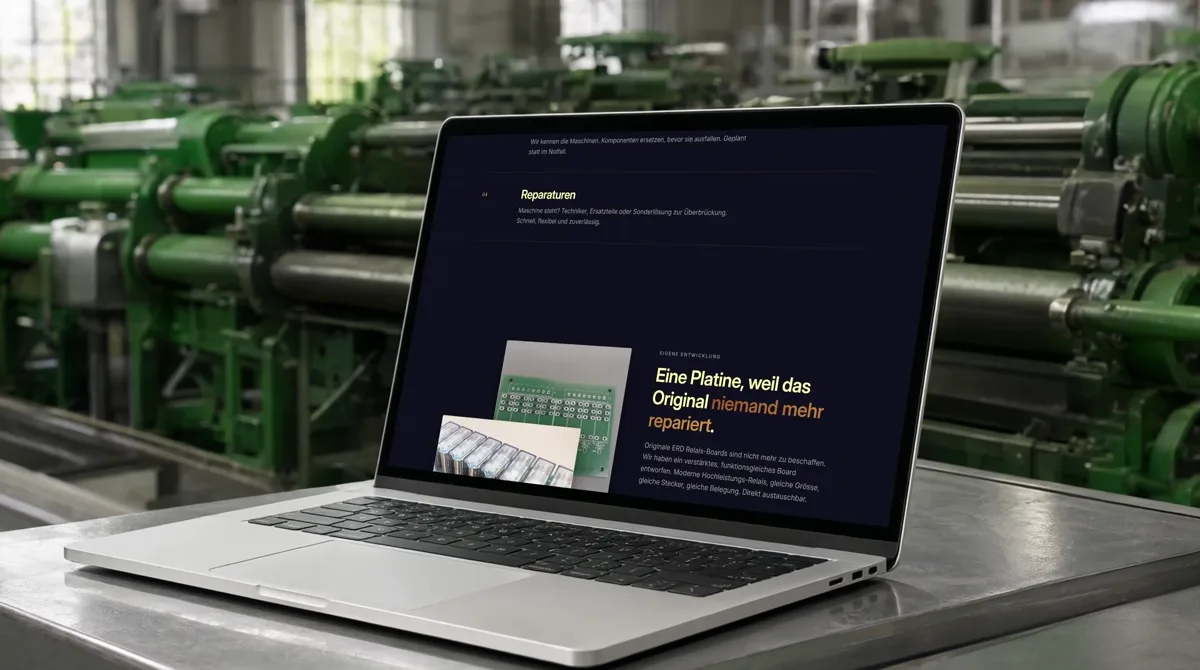
Walzpunkt AG in Reichenburg keeps the chocolate industry's roll refiners running, machines that have been refining cocoa mass between five rolls day and night for decades. When a control unit fails, the line stops, and the original parts vanished from the market long ago. For more than three decades, that has been the moment the phone rings in Reichenburg. In 2026, two things take shape with Orbit at once: a website that refiner operators all over Europe can find, and a workshop app that handles everyday work from the first call to the paid invoice. The client's rule is as simple as it is strict, and it has applied to every Orbit project since.
The catalogue is deliberately not a shop, because with machines like these every deal starts with a conversation. Every item ends in an enquiry that lands directly with the technician, from the Walz-Board, which takes ten to fifteen minutes to replace a relay board that has been unobtainable for years, to the dry-run protection that stops the machine within five to eight seconds, before the rolls run dry. Every product has its own address with photos, key facts and price, written so that search engines and AI assistants can read it. Anyone searching Google for a replacement ERD relay board should end up in Reichenburg.
Behind the website, everything serves the job. A call becomes a job in one move, with customer, machine and topic. Every hour on the line lands in the workshop log with initials and duration, every part fitted is drawn from stock, and the service report follows in one click. The job leads into the document chain: quote, order confirmation, delivery note, report and invoice, every invoice with a Swiss QR payment slip, and the bank reports back which ones have been paid. Nobody keeps a second list. The machine register works out the next service from the last one, supplier delivery notes are read instead of retyped, and wiring diagrams are imported into an editor based on IEC 60617.
The queue at the counter
Escape rooms, trampoline parks and laser tag compete for the same Saturday nights, and anyone who waits half an hour at the counter books somewhere else next time. At Lasergame Schweiz in Zofingen, until 2026, registering meant paper forms, ballpoint pens and a queue back to the door. Today the Register sorts the evening into three lanes, Bookings, Arrowtag and Open, each group a card with its time slot, a round counter and the initials of everyone who has already signed in. Every person accepts the terms and conditions and the liability waiver themselves, with a finger on the screen, and the system does not accept a registration without a signature.
The cleverest part is the least visible one. Every group card carries its own QR code, and anyone who scans it signs in on their own phone while the others are still standing at the counter. The code opens exactly that one group; a wrong or guessed one leads nowhere. So the queue spreads across twenty phones instead of one clipboard. In the arena, the Playboard shows every active group with its player names and works out from the clock and the time slot whether it is ready, playing or running over. Staff sign in with their Orbit account, and groups and registrations are stored in the business's own database, every evening from the first children's birthday party to the last Open round.
From clipboard to industry solution
In autumn 2023, 2nd Skin, seven tattoo and piercing studios between Zürich and Winterthur, wants to record consent forms, health details and IDs the same way at every location, legally sound, with five or more tablets per studio on promotion days, and all before Christmas. The prototype is built first in Figma and refined with the studio team until every customer can fill in their consent form themselves in a few minutes; what is in the prototype ends up almost line for line in the tool. It goes live shortly before Christmas 2023, on schedule. Returning customers are recognised with a single tap, and after every appointment the aftercare instructions go out with a voucher for the next visit.
Along the way it becomes clear that this is no one-off problem: every studio in the industry struggles with the same paper. The tool for one client becomes Inkbase, Orbit's platform for tattoo and piercing studios. A kiosk guides customers through registration in six steps, a QR code opens the same flow on their own phone, and if someone is under 18, Inkbase requires a guardian's details at two points that cannot be bypassed. Every signature remains tied to the exact version of the form that was signed, and every studio appears under its own name, in its own colours.
One inventory, one price, one truth
Kabelschweiz supplies cables and network technology from its warehouse in Switzerland and holds its own as a specialist between electrical wholesalers and online retailers such as Galaxus and Brack. Orders come in through its own shop, through marketplaces and straight from business customers' procurement software. The B2B platform Orbit designs for it in 2026 follows a single brief: one inventory, one price, one truth, no matter where the order comes from. A punchout entry point opens the catalogue from third-party procurement software and returns the basket, quick order accepts an Excel list and checks every line against price and stock, and anyone who wants deeper integration connects their ERP directly, from SAP to Abacus and Bexio. An order nobody ever has to type in is the fastest kind.
Because cables need explaining, the platform is meant to advise like a specialist dealer. The requirements calculator asks not about metres but about the building: floors, storey height, floor area, rooms and outlets per wall. You drag the building entry point anywhere, the runs get shorter in the middle and longer in a corner, and out comes a bill of materials in 305-metre boxes, as a basket or as a quote. The custom cable is configured as a 3D model by type, length, connectors and jacket, with a running price, and behind the shop a portal presents the same inventory for six roles, from sales with its pipeline to purchasing, where a forecast says which box to reorder when, before stock runs out.
In the language of the industry
You can tell good industry software by its vocabulary. For Next Hype, the Swiss 3D agency behind campaigns for NIKE, Adidas and Warner Bros, Nextdata is created: a project platform for leads, clients and the team, where there used to be ten chats, three clouds and a spreadsheet. Every project gets its own channel where clients, the team and an AI assistant post, comments attach to the file itself, on videos to the exact point on the timeline, and the wallet handles every payment inside the platform, with "Pay", "Claim" or "Grant" depending on the role. At Tactica Games in Dietlikon, the meeting place of the tabletop scene, purchased miniatures do not disappear into an order history but move into a collection with five stages from ordered to painted, the "Pile of Shame", and hobby XP is earned by taking part, not by spending money.
One foundation under everything
Every one of these applications is built on the same platform, which is why a new project at Orbit never starts from zero. Relay takes in a brand's design, breaks it into building blocks and builds the surface from them, and because Relay is built largely by AI agents, it trusts no claim, only a measurement: container by container, a rendering browser compares around 55 properties with the design. Every project has its own database, every tenant its own storage, and only what the payment provider has confirmed counts as paid.
Trajectory runs leads, projects, contracts and payments for all of Orbit's tenants. There, a contract is also the invoice, with line items, VAT, deposit and a Swiss QR bill; the client signs online and pays by card or TWINT, and at the end the fiduciary receives an accounting journal based on the Swiss SME chart of accounts. And on every interface Orbit delivers sits the "Bug gefunden?" button: every report becomes a row in the same table, with tenant, project, page and media, until someone has resolved it.
The business first, then the code
A project starts with a conversation about everyday work, not about technology: where is time lost, what is entered twice, what does only one person know? From that comes a design in Figma you can click through before a single line of code is written, and the code follows it, measured rather than claimed. Then the system grows in live operation: at Walzpunkt, the document chain, QR invoices, data sheets, wiring diagram import and customer search were added while the workshop was already using it day to day. Those who build it also run it, on Orbit's own servers in Switzerland, and at Orbit maintenance means the same people remain available.
Software built like the craft it serves is robust, honest and repairable. Anyone with a business that works this way, and tools that do not yet, will find, in Fahrweid near Zürich, the people who bring the two together.