
AI
AI for businesses: agents, assistants and voices that take on real work in the business, verifiable and on Orbit's own hardware in Switzerland.
- Built by: Orbit
AI for businesses: agents, assistants and voices that take on real work in the business, verifiable and on Orbit's own hardware in Switzerland.
Almost every company has tried a chat window by now, but few have one that actually gets something done in the business: writing an application, finding a customer, telling a workshop what is currently open. The difference rarely lies in the model. It lies in three questions that come before any line of code: what may the AI see, what may it do, and who checks what it has done? Where these questions remain unanswered, a model invents details nobody asked for, and an agent reports a task as done because the result looks right. Orbit therefore integrates AI according to fixed rules: invent nothing, a human decides, and what is measured is the result, not the report. And where data should not leave the company, the models run on Orbit's own servers in Switzerland.
• AI agents in internal tools • Leads from public registers • Texts, cover letters and briefings • Assistants that work on your own data • Living characters for websites • Speech and cloned voices • In-house image and 3D generation • Test benches instead of self-reporting
Nothing may be invented
Vapply sorts the Swiss job market not by job titles but by how you want to work, and turns a swipe into an application. One condition runs through every line: no sample job ad, no random date, no qualification the person has not entered themselves. A language model assigns every job ad one to three of nine vibes, from Hands-on to Bold, and every choice needs evidence, a verbatim sentence from the ad; generic virtues such as "team player" do not count. The data set behind it has been cleaned: in early October 2026 it holds 163,067 job ads from the major portals, from the Job-Room of SECO and the RAV and from company career pages, with every position merged across all sources into a single entry.
The cover letter is written by a language model on Orbit's own servers, and it may rely on two sources only: the job ad and what the person has said about themselves. The interview briefing comes from the job ad, and whatever is not in it becomes a question for the employer, never a claim. For the RAV, Vapply fills in the official form with the real application data, and an application is only sent if the person has agreed both when applying and when sending. The AI drafts, the person decides what goes out in their name.
The moment a company buys
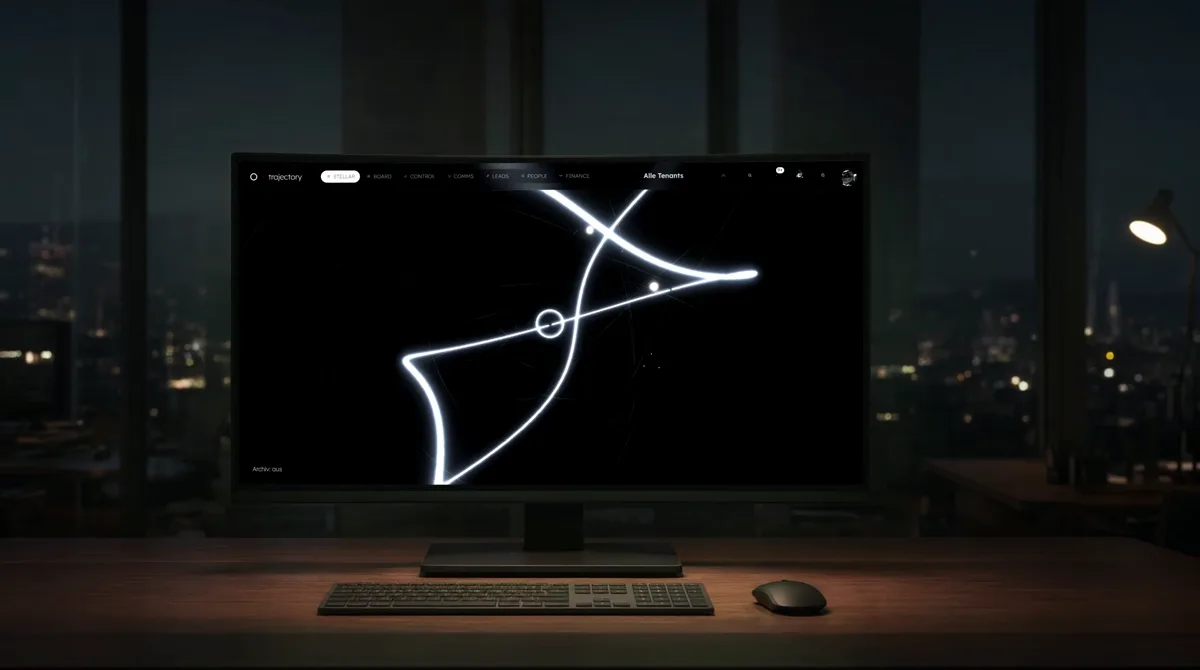
The moment a company buys is a matter of public record in the Swiss Official Gazette of Commerce: an incorporation, a new name, a new purpose, new management, a move. Since the end of September 2026, the lead engine in Trajectory, Orbit's cockpit, reads around a thousand such notices every working day, checks what the company's website is missing, and awards a score with a reason for every point and one of the classes A, B, C or X. For Walzpunkt AG, the same principle works inside the Werkstatt App: a search run takes target industries and countries, queries the commercial register and gazette in Switzerland and the registers of several European countries, reads and rates thousands of companies and finds, for the best ones, the people who matter: workshop management, maintenance, engineering.
What the machine does not do is just as much part of the design. Every score is explained, so a person can follow it in seconds. The engine stores people only in their business role. And only a human turns a candidate into a lead, with "Accept": the AI reads a thousand notices so that someone can call the right ten.
Agents on a leash
AI agents are only as good as the direction they are given, and Orbit directs its own every day. In Control, every job is a row with intent, goal, stage and status, gates show which checks a change has to pass, and a scoreboard measures the agents on real values instead of their own reports. In the Hangar, every instance stands as a rocket on its pad, next to a live stream of what the agent is reading, writing and planning right now.
How seriously this is taken is shown by Relay, the service through which every Orbit website and app is delivered. It is built largely by agents, and that is precisely why the browser has the final say there: a building block is called "drafted" until a check has passed, and only a human changes the checking tools themselves. Anyone who wants to use agents in their own business benefits from exactly this experience at Orbit: how to give them work without giving them the last word.
Asking your own data
The most useful AI in a business is often the least conspicuous: one that answers from the business's own data. In the Walzpunkt workshop, people ask WalzChat what is going on, and the answer comes from the workshop's data, not from the internet. In Nextdata, an AI assistant posts in the project channel alongside clients and the team. And in Trajectory's header sits the AI: a question there goes to Orbit's own language model on Orbit's servers, not to a service somewhere abroad. For a company whose data is confidential, that is not a technical footnote but a prerequisite.
A character instead of a speech bubble
On most websites today, a speech bubble waits in the bottom right corner. Pulse, designed by Orbit as a product and operable as an interface, takes a different approach: a brand uploads a portrait and gets a character that lives on its website. It breathes, looks, reacts and does something when spoken to. The portrait becomes a library in five categories, idle, action, effect, transition and two-part scenes, and every scene starts and ends in the portrait so the next one follows seamlessly. A state machine decides which one plays next, and if a clip is ever missing, a viewer keeps the portrait ready as a fallback. On a third-party website, Pulse needs exactly one script and one element, and only the next scene is ever loaded.
A voice that answers
How far speech technology has come is shown by Starfield Ultimate, a speech layer for Bethesda's Starfield, built in 2026 as Orbit's own project. Hold the key and speak, and you get a freely worded answer in the character's cloned voice, with subtitles and, if the character wants, an action: follow, wait, flee. The game's own lines yield 1,073 voice types, the 420 voices of the named characters are individually tuned, and every cloned voice is tested against real lines of the same character that were not used for cloning. Each character has its own memory: what you tell one, the next does not know.
What matters is the test bench. It talks to the people nearby through the same channel as the microphone and measures every answer: the right person, the right voice, and a secret stays with the person it was told to. Every voice assistant that is one day meant to greet customers on the phone or at the counter needs the same discipline.
Generating in-house
In Parallax, Orbit's creative studio, images and 3D models are made on Orbit's own graphics card in Switzerland, not in someone else's cloud. No model comes straight from the internet: each one sits in Orbit's own model store, with revision and checksum, before it runs for the first time, and the queue is visible, with status, model and progress. With "Speculate", the same intent runs several times side by side, and the variants come back as a grid, ordered by the agent's confidence. The document stays untouched until a human accepts a variant, and a counter in the margin shows what the suggestions cost.
Start small, stay measurable
An AI project at Orbit does not begin with a model but with a recurring task: who loses time on what today, and how would you notice it had got better? From that comes a first, small step with clear permissions and a person who checks the result. It runs in day-to-day operations, is measured and is only extended once it has proven itself. That way AI is not an experiment on the sidelines but a colleague whose work you can check, and who never has the last word.
Anyone with a task like this in their own business will find, in Fahrweid near Zürich, the people who teach it to a machine without handing over control.