
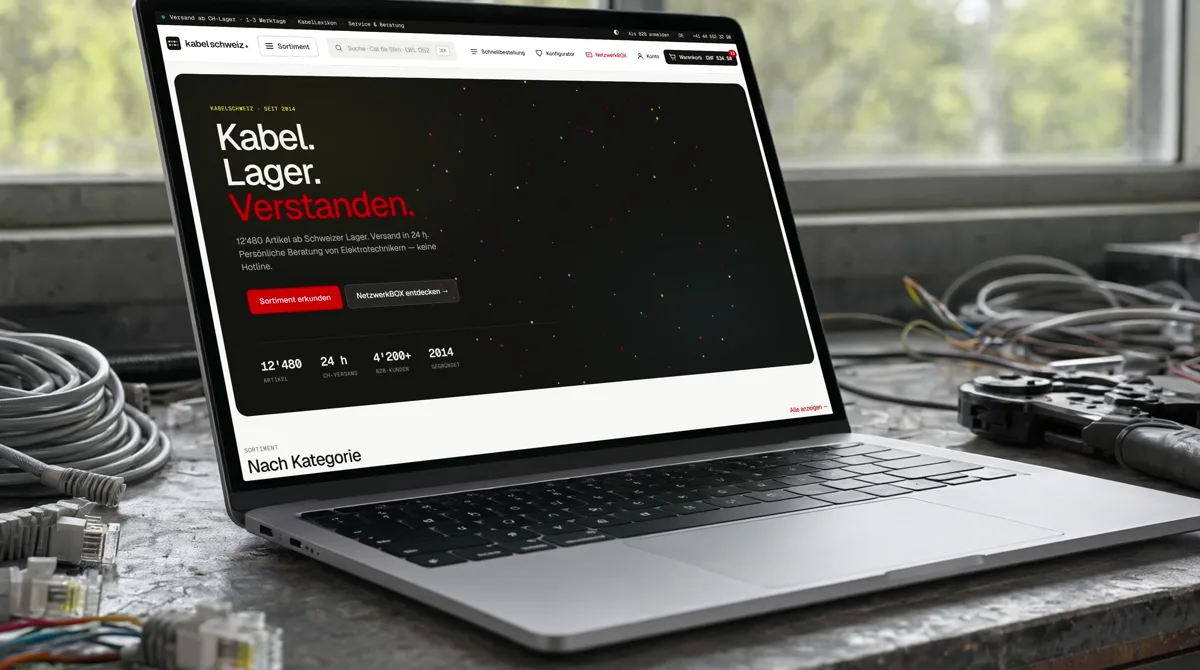
Kabelschweiz
Kabelschweiz supplies cables and network technology from its warehouse in Switzerland to electricians, system integrators and IT departments. Behind every metre of cable are the same three questions…
- Client: Media Connect Distribution GmbH
- Built by: Orbit (Jan, Marcel, Sebastian)
- Period: 2026
Kabelschweiz supplies cables and network technology from its warehouse in Switzerland to electricians, system integrators and IT departments. Behind every metre of cable are the same three questions: which one, how much, by when?
The Swiss market for network technology is shared by large electrical wholesalers and online retailers such as Galaxus and Brack. Kabelschweiz, the brand of Media Connect Distribution GmbH, holds its own between them as a specialist and has long sold through more than just its own shop: orders come in via marketplaces, business clients order straight from their procurement software, and behind every order are sales, order processing, purchasing and accounting. In 2026 Orbit designs a B2B platform for all this that is shop, interface and workspace in one. The requirement: one inventory, one price, one truth, wherever the order comes from. And because cables need explaining, the platform is not only to sell but to advise like a specialist dealer.
• Shop and B2B in one • Quick order and punchout • Requirements calculator and custom cables • Cable lexicon with editorial workflow • NetzwerkBOX and sample box • Customer portal with approvals and limits • Sales, orders, purchasing, finance • Connection to ERP and marketplaces
Procurement, not shopping
In business with companies, a single person rarely decides alone, and the order begins in the customer's system. Via a punchout entry point, third-party procurement software opens the catalogue and receives the basket back. Quick order accepts a list of item numbers and quantities, or an Excel file, checks every line against price and stock, and puts everything in the basket in one step.
A company account has several users, each with an order limit of their own. Anything above it goes for approval, with a reason, the amount and a single button. In the morning the dashboard greets users with pending approvals, budgets and their personal contact, and every order, quote and invoice is ready as a PDF.
Customers who want deeper integration connect their ERP directly: SAP, Microsoft Dynamics, Abacus, Bexio, Sage or SelectLine, with orders going in and delivery notes and invoices coming back. An order nobody ever has to type in is the fastest kind.
A calculator that turns metres into boxes
The most unusual piece is the requirements calculator. It asks not about metres but about the building: floors, storey height, floor area, rooms and outlets per wall. The building entry point can be dragged anywhere, and that changes the metres: in the middle the runs get shorter, in a corner longer. The result is a bill of materials with installation cable in 305-metre boxes, modules, patch panels and patch cables at catalogue prices, as a basket or as a quote with a code that restores everything.
Alongside it, the custom cable is configured as a 3D model by type, length, connectors, jacket and labelling, with a running price, from a single piece to a bulk order.
Advising like a specialist dealer
Because cables need explaining, a cable lexicon is a fixed part of the platform. It explains categories and standards from Cat 5e to Cat 8.1, fibre, PoE, shielding and jackets, each with its own illustration. Every entry shows the matching products, and every product links back to its entries. It is maintained in a dedicated editor, with drafts, approval, linked items and the fields search engines read.
Packages instead of parts
Two products are packages rather than cables. The NetzwerkBOX is a home network in a box: six connections, each with a slim cable in its own length and colour, plus ready-made sets from the studio flat to the home office. The sample box is aimed at professionals, from the free folder with eight cable cross-sections to a small rack for the showroom, with real connectors instead of offcuts.
Six views of one inventory
Behind the shop lies the portal, and it presents the same data for six roles. Sales sees every company in a 360-degree view with revenue, open quotes, last contact and a health score, plus a pipeline from lead to deal whose entries are moved around like cards.
Order processing takes every quote through the whole chain to the invoice: quote, order confirmation, delivery note, invoice, with the margin shown live alongside, before any document leaves the company.
Purchasing gets suggestions instead of gut feeling: a forecast reads season and demand per category and proposes which box to reorder when, before stock runs out. Next to it is the inventory with its coverage in days, category by category.
And management sees the big picture: revenue against plan, liquidity, debtors and a KPI cockpit benchmarked against the cable wholesale trade. The real art lies in doing it all at once: orders from the shop, from the marketplaces and from third-party ERPs land in the same inventory, with the same prices and the same availability.
The next platform, already designed
Kabelschweiz has not yet decided on the new platform: the existing shop and the marketplaces carry the business, and you do not replace a B2B platform while the existing one does its job. Even so, it is fully designed, shop and portal in six views, and a prototype is running; the first step would be connecting it to the existing catalogue. For a specialist competing with the big players, that is the difference between a shop and a tool its customers work with.