
Bauteiljagd
Bauteiljagd: windows, doors, kitchens and lamps that come out of a deconstruction and deserve a second life. atelier faire avec builds in the canton of Solothurn with what has been built in once…
- Client: Atelier faire avec
- Built by: Orbit (Jan, Marcel)
- Period: 2026
Bauteiljagd: windows, doors, kitchens and lamps that come out of a deconstruction and deserve a second life. atelier faire avec builds in the canton of Solothurn with what has been built in once before, and Bauteiljagd is its marketplace for exactly that, from the bare shell straight into the next kitchen.
Construction waste is the largest waste stream in Switzerland, and much of it is still in good condition: windows, doors, kitchens, lamps. However, a used building component has no data sheet. It has a condition, a year of construction, a weight, and a location where it is often still installed. Whoever dismantles stands in the bare building with a phone and has little time; whoever buys wants to know before the trip whether the part fits and who will remove it.
2026 brings atelier faire along with Bauteiljagd to Orbit, in the funding program of the Canton of Solothurn. The scope includes the concept, the wireframes, the design of the mobile application as a clickable prototype in Orbit Relay, and a dedicated brand foundation with logo, colors, and typography. The goal is as simple as it is ambitious: Reusing should become as convenient as buying new.
• Marketplace for components from dismantling • List and map as equivalent views • Construction sites with zones and floors • Entry in four steps, with one hand • Suggestions for category, eBKP-H, price, dimensions and weight • CO₂ balance for listing and order • Dismantling service per component • Cockpit for the service partner • Team codes instead of passwords • Entry also without network
Three roles instead of two
A marketplace for components features a role that does not exist in any ordinary shop: the service partner, who removes a part on site if the buyer cannot do so themselves. Between the team that dismantles and the people who build new or modify, he turns a listing into a deal. Every view of the component hunt is therefore designed for one of these three roles, and none sees more than it needs.
From Wireframe to Design
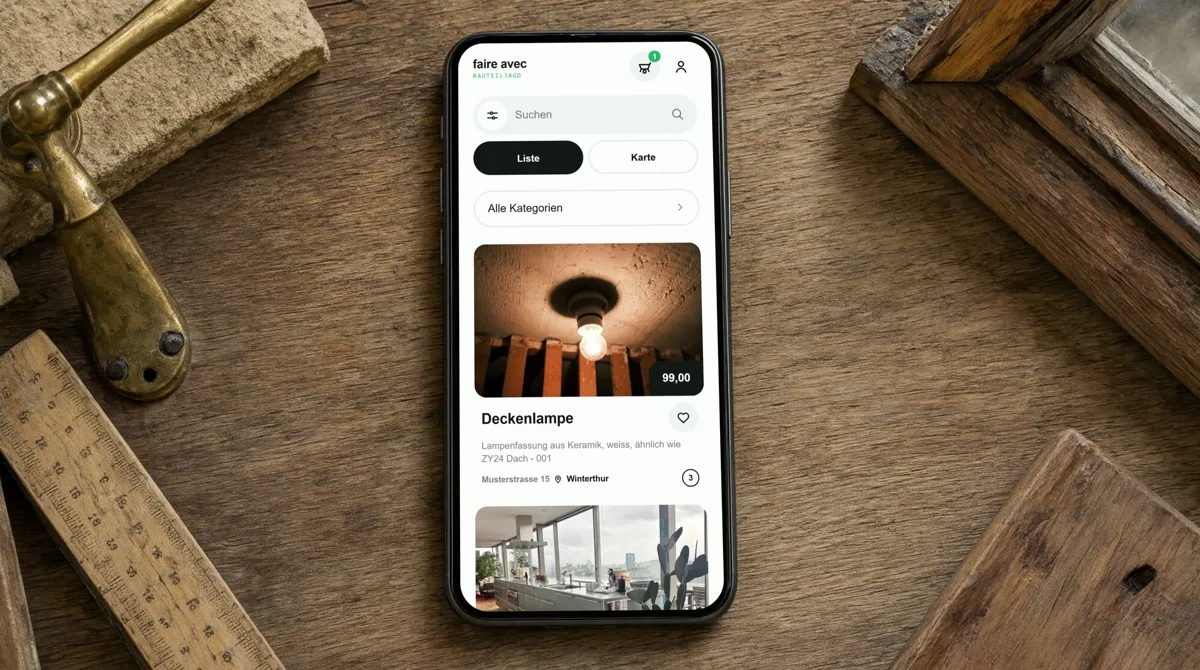
The work begins in black and white. In Figma, wireframes are created first for each view: the homepage with search and filters by canton, price, and category, the component card, the shopping cart with the dismantling service, the wishlist, and the footer with the note about the funding program. No color distracts; every decision is about content and flow.
Only once the workflows are in place does the color come in: a bright, calm image in which the photos of the components play the leading role, with a strong green for everything that leads further. The design becomes a clickable prototype in which every view reacts realistically, and it can be adjusted to the brand in accent color, mode, corner radius, and font. This allows the component hunt to be shown, tried out, and tested with partners, long before the first lamp is sold.
From the shell to the ad
Data capture does not begin with a form, but with the construction site. A team opens it with a name and a pickup address, creates building zones, such as a wing or an outbuilding, and within them the floors from the basement to the roof. Each component is attached to its floor and can be moved between floors.
The listing is created in four steps, which you can manage with one hand on a construction site: construction site, title, quantity, and condition in four stages from like new to needing restoration; two photos in the installed state, an overall view and a detail; suggestions for category, eBKP-H class, price, dimensions, and weight, which can be marked as estimated; finally, publication, dismantling service, pickup, and the account for the payout. Without a network, you can continue to record parts, because in the rough construction phase there is often no reception; changes are made as soon as the connection is back up.
The suggestions in the third step take the most tedious work off the team's hands: From the two photos, Bauteiljagd suggests a category, an eBKP-H class, a price, as well as dimensions and weight. Those who know more precisely tap the value and adjust it, and everything that is only estimated carries this note in the listing. This keeps a listing honest, even if no measuring tape is at hand in the raw structure.
Buy with pickup appointment
Those who search start in the list or on the map, where each item is located at its pickup point. Filters narrow down by canton, price range and category, from kitchens and lamps to windows, doors and floors, all the way to paving. Each listing calculates how much CO₂ reuse saves compared to a new purchase.
The shopping cart bundles what is picked up together, and a local disassembly service can be added for each item. At the checkout, the CO₂ avoided for the entire order is displayed, both parties then agree on the pickup date directly, and payment is made by card, TWINT, Apple Pay, PayPal, or on invoice with 30 days. Under the user's own account, purchased items, sold items, and the wishlist are displayed side by side.
The Service Partner's Cockpit
When a team at a construction site requests a dismantling, the request lands in the Cockpit of the service partner and goes through fixed stages: inspection planned, quote sent, confirmed or rejected. The team sees every stage on their construction site. Listings can be released or blocked, reports via «Problem melden» are answered by the partner directly via WhatsApp, and an overview shows avoided CO₂, active listings, orders, mediated revenue and the commission.
There are no passwords. A device joins with a team code, and each additional device joins via a new code. This way, a team in the rough construction phase is ready to start in seconds, without an account and without a forgotten password.
Every lamp that wants to shine once more
The concept, wireframes, design, and brand foundation of Bauteiljagd are fully developed, and the prototype guides through every workflow, from the rough build to pickup. atelier faire avec chooses the launch itself, as soon as components, seekers, and a service partner come together. What Bauteiljagd promises is already true today: The most sustainable component is the one that has already been built.