Annihilation
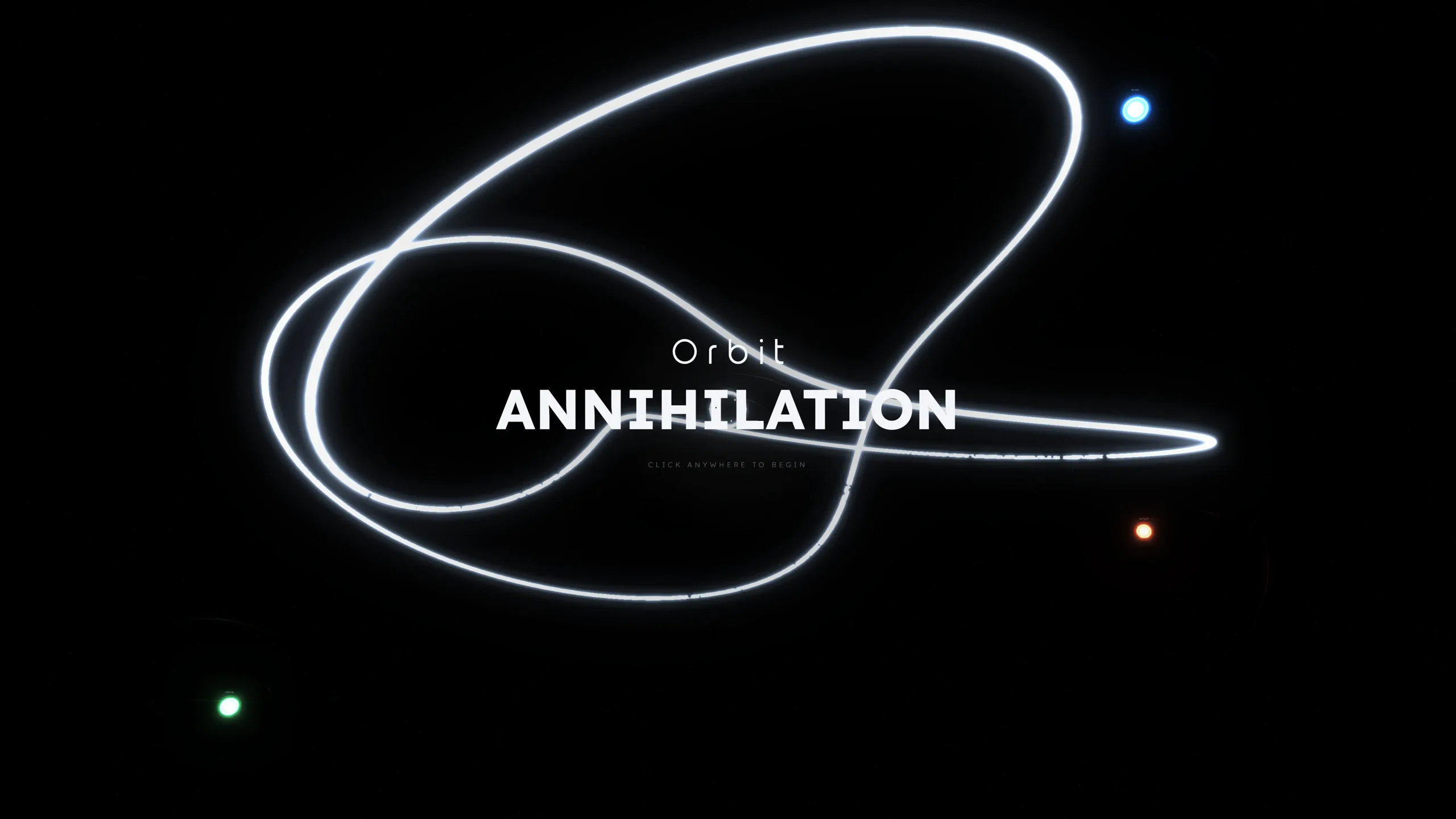
Annihilation: real-time strategy across a whole galaxy, right in the browser. Every match takes place in a galaxy that never existed before.
- Client: Orbit GmbH
- Built by: Orbit
- Period: 2026
Annihilation: real-time strategy across a whole galaxy, right in the browser. Every match takes place in a galaxy that never existed before.
Large-scale real-time strategy has its classics, from StarCraft to Supreme Commander: armies, bases, fleets and ultimately whole worlds as the playing field. It is played on gaming PCs, after downloading gigabytes. Annihilation, an in-house brand of Orbit, brings that feeling into a browser tab: no installation, with mouse or touch, alone against up to three AI opponents or over the network against other people. Before the player lies a galaxy of stars, planets and moons, and every world can become a base, every sun a source of energy and ultimately a weapon.
• Real-time strategy in the browser • A galaxy from one seed • Up to three AI opponents • Multiplayer in lockstep • 33 buildings, 24 units, 10 ship classes • Five star structures • Dyson spheres and planetary engines • Mouse and touch
A galaxy from one number
The map is not drawn, it is computed. From a single seed come stars, planets and moons, their orbits, their surfaces and the ore veins in them. The same seed produces the same galaxy on every computer: every match is new, yet the same for all players. Anyone wanting a tougher challenge plays Hardcore. After one to six hours a black hole awakens at the centre and devours the galaxy from the inside out.
Before the start, players decide for themselves what the galaxy looks like: three to twelve suns, on average one to ten worlds around each sun, up to three moons around each world and planets up to eight times their normal size. Add up to three AI opponents, as a team or every one for themselves, and a choice of how rich the ore veins run. The seed can be shared: pass it on, and exactly this galaxy goes with it.
A tower, then a base
Every match begins with a command tower placed on a world. It assembles itself in about ten seconds and deploys construction drones. At first there are only two things to do: build solar fields, whose yield falls with the distance to the sun, and extractors, which can only be placed on ore veins. The veins are unevenly spread. The richest yield 2.2 times as much, and on rare occasions a world sits almost entirely on ore. Pick the right world early and you build faster later.
The same AI base after 3, 9 and 18 minutes of play, from a real match.
Three tiers of technology
The foundry raises the technology tier. Each tier brings its own builder, the constructor, the engineer and the architect, and only the matching builder erects the buildings of its tier; the architect builds four times as fast as the constructor. Fusion reactors make the base independent of the sun, and every habitat module speeds up the foundry by 18 per cent. The big structures have prerequisites: the death ray can only be built once the research lab, railgun and missile silo are in place.
Alongside building, research runs in five branches: weapons, propulsion, sensors, shielding and capacity. Each level adds 12 to 15 per cent more damage, speed, vision, shield radius or storage, and every further level costs more than the one before.
Combat with counterbalance
Five weapon types meet five armour types, and every pairing has a fixed factor. Flak clears the sky and barely scratches buildings, siege weapons smash buildings and hit nothing in the air, lasers beat aircraft and light units. 24 ground and air units are spread across these roles. No single unit wins on its own; matches are won with the right mix.
Defence comes from towers for every situation: gatling towers against anything in the air, flak towers against anything in orbit, railguns with extreme range reaching into orbit, artillery against buildings. Shield domes absorb incoming fire, barricades are drawn as a line across the world, and a shadow generator hides the base from the enemy’s radar.
Into orbit
From the launch pad a rocket flies to any world and becomes a space station there. Stations provide vision and energy and are a match's second anchor: a player is only eliminated once they have lost the command tower and every space station. In orbit, ten classes of warships cruise, from the corvette through destroyers and carriers to the titan and the battle carrier, each with its own momentum and manoeuvrability.
Suns as building sites
Anyone who fully encloses a sun with a Dyson sphere gains almost unlimited energy and plunges the worlds of its system into darkness; half a sphere delivers nothing. The finished sphere unlocks five star structures. The star lance charges the star and cracks a world open. Go Nova drives the star into a supernova and wipes out the whole system. The star drive pushes the system through the galaxy, the super gate moves fleets almost instantly, and the star forge builds the largest ships.
Dyson sphere under construction, star drive and Go Nova. These scenes and the star gate further down were set up with the game's test tools; in a match they come at the end of a long road.
Worlds as projectiles
Three planetary engines turn a planet into a vehicle. With them the command tower shifts the orbit, pulls the world to another star or rams it into an opponent. If your own world is heavy enough, the target is destroyed completely, otherwise only the part that was hit, and the ramming world remains as a wreck.
The last word
For the endgame there are structures that cannot be defended against. The death ray cracks a world open with a single beam, Ragnarok drills down to the core and makes the planet implode. Missile silos destroy a base with one hit unless an interceptor battery protects it. And the mega star gate charges inside a closed Dyson sphere until its horizon opens.
An AI base in a real match, then a beam and the message: a world has been destroyed.
Opponents that really play
The AI opponents build economy, technology and fleets by the same rules as a human player. In long test series they attack for the first time after one to ten minutes, a player who does nothing is eliminated after ten to 25 minutes, and most matches are decided after 15 to 35 minutes. Players who lose can keep watching: the spectator mode reveals every world, and the AI plays on. Every base on this page was built by AI opponents themselves in real matches.
An AI expands: the same world after eight and after sixteen minutes of play, in a real match.
The three AI bases of the same match after 15 minutes, each built by its own AI.
Multiplayer in lockstep
In multiplayer the browsers connect directly to each other; the server only brokers the connection. Every machine calculates the same match from the same seed, only the commands are transmitted, and so the simulation stays identical everywhere, byte for byte. A lobby and rematches are included.
From prototype to open game
Version 0.1 was ready in June 2026: a galaxy, bases, units and the first AI opponents. Over the summer, the star structures on the Dyson sphere were added, along with the star lance, new flight mechanics for everything in orbit and multiplayer with its lockstep simulation. Before the opening in October 2026, the game and network were tested, and long test series against the AI ironed out the last bugs in the late stages of play.
A galaxy in a tab
Annihilation is publicly playable in version 0.1, right in the browser at annihilation.orbit.zuerich. Next up are fleet formations and more movement in orbit. And every match shows in passing what real-time 3D in the browser can do today: a whole galaxy in one tab and a simulation that runs identically on every machine, without anyone having to install anything.