3D visualisation
3D visualisation near Zürich: products, buildings and characters as a model from which every further image is made.
- Built by: Orbit
3D visualisation near Zürich: products, buildings and characters as a model from which every further image is made.
A product photo needs a sample, a studio, a photographer and a booking, and for every colour, every flavour and every language it all starts again. Fruit no longer looks fresh after an hour under studio light, a building that does not exist yet cannot be photographed at all, and a wheel about to launch may exist only as a CAD file on the engineer's desk. A 3D model needs all of this only once. After that, packshots, posters, films and real-time scenes come from the same file, in every colour, every format and from every angle. Orbit builds such models and the images that go with them, from the bottle to the building, for print, web and campaigns. Many of the projects on this page were created between 2020 and 2023 with Jan Stalder at Geyst AG, the more recent ones at Orbit.
• Product visualisation and packshots • Key visuals for campaigns • Architectural visualisation, exterior and interior • Product films from CAD data • Photogrammetry of real objects • Characters and collections • Real-time scenes in Unreal Engine • Render passes for edit and grading
No bottle in front of a camera
Mineral water is a fiercely contested shelf, and flavoured waters make it even more crowded. For the launch of Valais Botanical, the second line of the mineral water from Aproz, Jan Stalder proposes in 2022 something nobody at Valais had tried until then: no longer photographing the bottles at great expense, but building them entirely in 3D. Three flavours, each with its own arrangement, raspberry with verbena, apricot with elderflower, later lemon with mint, each as a single bottle and in a 6-pack, with and without condensation, in three languages: with the old process, every variant would have needed its own shoot. With the new one, the bottle is a model, the label a separate part right down to its creases, and every fruit and every blossom an individual model from a kit.
From the kit, every key visual grows in four stages, from the bottle with half a fruit to the full arrangement: the sparse stage for a small ad, the full one for the poster at the railway station. A new language only takes a new line, and when lemon-mint is added in February 2023, packshots and 6-pack are ready at the end of February and the key visual in March, without a single shoot. In May 2023, poster motifs are additionally made in Unreal Engine 5, with scanned plants. On the shelf, nobody noticed that not a single bottle was placed in front of a camera for this campaign.
From CAD to film in twenty minutes
RONAL is one of the leading makers of alloy wheels, with around 7,000 employees and plants in twelve countries. Every year the group presents its new models in the "Wheel Aesthetics" campaign: short films, always the same camera, always the same light, and for every model the work starts from scratch at an outside supplier. In 2021, at Geyst, Jan Stalder sees in this not a production but a pattern, and within three months a pipeline takes shape in Unreal Engine 5 that turns a CAD file into the finished film: one base scene per brand, materials from a catalogue, lighting from fixed setups and two cameras, "Legacy" for the look the campaign has had for years, and "Geyst" for a fresh proposal.
After around 20 minutes, film and stills are ready in 4K, in portrait and landscape. And because a shade lost between engineer, agency and renderer costs more time than any render, a material configurator is built alongside: the wheel's engineer sets colour, clear coat, roughness and metallic directly, sees the result instantly on a material sphere and sends an image whose file name contains the wheel and its materials. Anything produced the same way every year is worth building right once.
An audience from the oven
Anyone who promises naturalness cannot convey it with images that look computer-generated. In the spot "Festival Minis" for the premium butter Floralp, the pack stands on a festival stage, and a crowd made up entirely of little bread rolls cheers in front of it, right up close to the camera, with crust, cracks and sheen. So the rolls are not modelled but baked: each one sits on its own thin rod in the studio, with between 113 and 167 shots per roll, and photogrammetry turns every series into a model with textures at 4096 pixels. The eyes are separate models, kept apart from the bread, so that most rolls simply remain bread and only a few look towards the stage. That is exactly where the viewer's eye goes first.
A bank in a snow globe
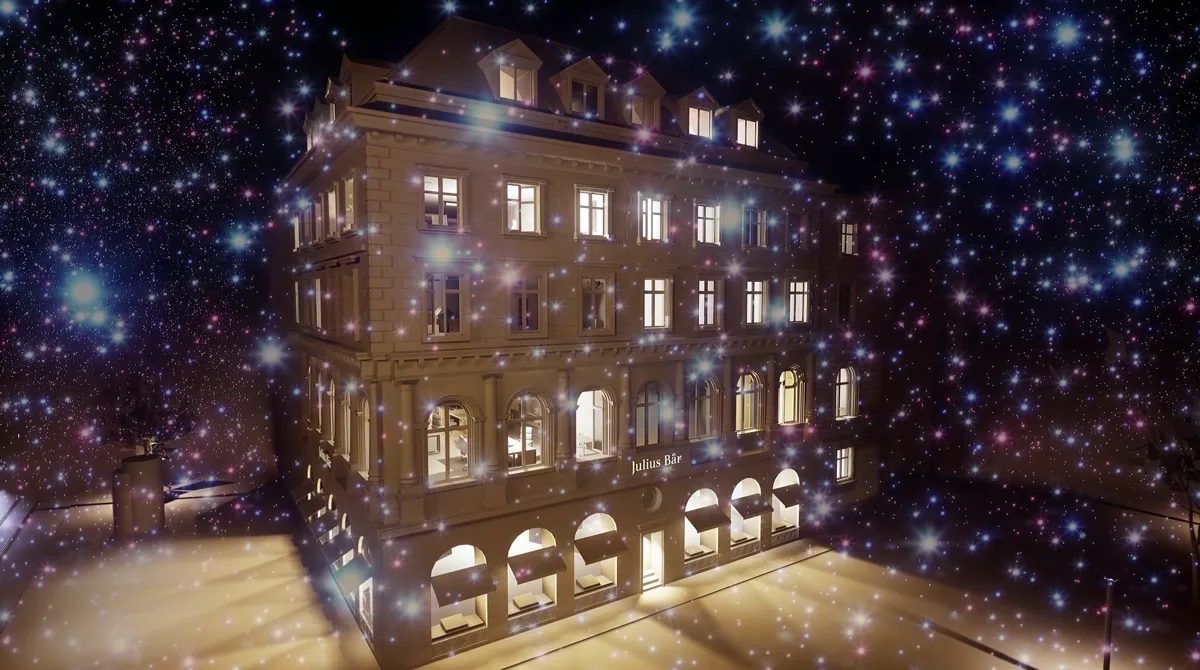
In private banking the brand is the product, and Julius Bär holds its year-end card to a higher standard than a whole quarterly catalogue. In 2021, Geyst tries 3D for the first time for this card: in Maya, a stylised snow globe takes shape, the bank's building between fir trees and snowflakes, all in white, as calm as a snowy night. The following year the globe becomes a street. The building on Bahnhofstrasse is recreated in full in Unreal Engine 5, with lit windows and furnished offices, and "Lucy", Zürich's Christmas lights, hangs over the street. Rather than a single image, the render produces passes, building, snow, windows and the lights once in colour and once in white, so each can be tuned individually in the edit until the evening looks exactly the way the bank envisions it.
A building before the first beam is up
Anyone who buys a flat that does not yet exist is buying an image. For the Lindenbaum development by Marc Hess Architekten in Oberweningen, three houses of pre-greyed wood with steep gable roofs, the practice wanted images that sell the project and still show exactly what will be built. The planning software delivers a model with correct dimensions and grey surfaces; everything else an image needs is only created during the commission. In 2024 Orbit prepares the model in Maya component by component, new slatted blinds, new window frames, a roof with tiles, dormers and solar panels, Twinmotion adds terrain, street, trees and furniture, and lighting and cameras are created in Unreal Engine.
The images keep to the architect's colour and material concept, component by component: vertical cladding of pre-greyed wood, window frames in wine red RAL 3005, the same red on doors, letterboxes and balcony railings, matt black blinds, dormers of titanium zinc. Inside, a flat is furnished, from the kitchen to the bathroom, because those are the rooms people ask about first at a viewing. On 5 December 2024 the ten images are produced in four minutes, four minutes that took three months. And the scene remains: another view is a new camera in the existing model, not a new project.
333 characters, none by chance
With MINDDS Eternals, the characters of the artist Dario De Siena step out of the frame: 333 characters, brought into the third dimension by hand, each as a ten-second loop at 2500 by 2500 pixels. Where other collections let a random generator assemble their characters from parts, Geyst builds its own editor in Unreal Engine 5, in which textures, light, hairstyles, horns and eyes are mixed and every character is curated individually. Each of the 24 combinations of six base shapes and four crown tiers is assigned by hand, and the rarest ones are placed, not drawn. For NFT NYC 2022 it becomes an entire light room with four projection surfaces and a three-minute choreography.
One model, many images
Once you have a product as a model, you have more than an image: every new colour, every campaign and every film starts from that file instead of a new shoot. At Orbit this path now runs through Parallax, the company's own creative studio, where layout, motion, 3D and video sit in one document. Its library shows each of its 159 materials as a path-traced preview rather than a flat colour swatch, and rendering runs as an image sequence at fixed quality, so frame twelve looks like frame one. Since October 2026 the videos on the case pages of orbit.zuerich have also been made in Parallax, and each one is measured before it goes online: frame count, black frames, hard cuts, the seam at the end of the loop.
And where an image is not enough, 3D becomes an application: Annihilation, Orbit's real-time strategy game, computes a whole galaxy right in the browser. What began at Geyst as an experiment for a Christmas card is now a discipline that ranges from packshots to real-time scenes. Anyone who wants to show a product, a building or a character before it exists will find the people who build them in Fahrweid near Zürich.